

How total bases are counted
| Result | Total bases | Counts for a hits prop? |
|---|---|---|
| Single | 1 | Yes |
| Double | 2 | Yes |
| Triple | 3 | Yes |
| Home run | 4 | Yes |
| Walk or hit by pitch | 0 | No |
| Stolen base | 0 | No |
| Reached on error or fielder's choice | 0 | No |
Strikeout board for the listed starters
| Starter | K/9 | Avg K, last 5 | Avg outs, last 5 | ERA | WHIP |
|---|---|---|---|---|---|
 Chris Sale Chris Sale | 11.07 | 8.0 | 20.2 | 2.16 | 0.98 |
 Nick Pivetta Nick Pivetta | 10.90 | 4.4 | 13.0 | 2.86 | 1.01 |
 Carlos Rodón Carlos Rodón | 9.71 | 6.6 | 18.0 | 2.67 | 1.06 |
 Dustin May Dustin May | 8.90 | 4.4 | 10.2 | 4.70 | 1.32 |
 Yoshinobu Yamamoto Yoshinobu Yamamoto | 8.85 | 7.4 | 20.0 | 2.53 | 0.87 |
 Max Fried Max Fried | 8.31 | 5.0 | 15.8 | 2.80 | 0.99 |
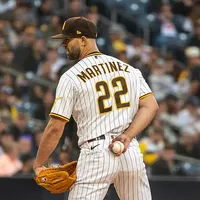 Nick Martinez Nick Martinez | 5.45 | 3.6 | 15.8 | 3.10 | 1.09 |
Strikeout and outs props are usually set near a pitcher's recent averages. A short leash or a high pitch count can cap both, whatever the strikeout rate.
Most MLB prop bets are not about who wins. They ask a narrower question: will this starter get 6 strikeouts, will this hitter reach 2 total bases, will anyone score in the first inning. That narrowness is the appeal. You can have a real opinion about one pitcher against one lineup without caring about the bullpen that takes over in the seventh.
This guide walks through the main baseball prop bets you will see on a US board, how each one settles, and the handful of inputs that actually move them. If you want the pitching side first, the daily probable starters are the place to begin, because nearly every player prop starts with who is on the mound.
How MLB prop bets are priced
A prop is a two-way market like any other. A strikeout line of 5.5 with the over at -125 and the under at -105 tells you the book leans toward 6 or more. Convert those prices to implied probability and they add up to more than 100%, which is the margin. On a standard side or total the classic hold comes from -110 on both sides, about 4.5%. On MLB betting props the two sides often add up to 106% or 108%, and on niche lines even more.
Why the wider margin? Books offer hundreds of player lines every day, they have thinner data on each one, and they get less money to push the price into shape. So they protect themselves with a fatter cushion. That cuts both ways for you: the cost of playing is higher, but a sharp opinion is more likely to find a line that has not been corrected yet. If you want to see exactly how much a pair of prices costs you, the odds calculators will convert both sides and show the hold.

Pitcher player props
Pitcher markets are the backbone of baseball prop bets and the most liquid of all MLB prop bets, and the four big ones are strikeouts, outs recorded, earned runs and hits allowed.
Strikeouts are the most popular. The obvious inputs are the pitcher’s strikeout rate and the opposing lineup’s tendency to swing and miss. The less obvious one is workload. A pitcher who strikes out 30% of the batters he faces can still miss a 6.5 line if the team pulls him at 80 pitches. Before you bet an over, ask how deep he usually goes. A starter who averages around 22 batters faced per outing needs a strikeout rate near 30% just to expect about 6.5.
Outs recorded turns that workload question into the whole bet. A line of 17.5 outs means you need him to finish the sixth inning, since six full innings equal 18 outs. Pitch count, the manager’s habits, a tired bullpen the night before and whether the pitcher is coming back from injury all matter more here than how good he is.
Earned runs and hits allowed are noisier. One bloop single and a hanging slider can flip an earned runs under in five minutes, and scorer decisions on errors can decide the result. These lines tend to be priced around 2.5 runs and 4.5 or 5.5 hits, and they depend heavily on the ballpark and the defense behind the pitcher.
Action vs listed pitcher on props
For sides and totals you can choose “action” (the bet stands no matter who starts) or “listed pitchers” (void if either named starter is scratched). Pitcher props work differently. They are tied to that player, so at most US books a strikeout or outs prop is void if he does not start. If he starts and is removed after one batter, the prop usually stands and you lose the over. That is the scenario that hurts: a comebacker off the forearm in the first inning settles your 6.5 strikeout over as a loss. Read the house rules for the exact wording, because they are not identical across apps.
Batter player props
Hitter markets are the busiest corner of MLB betting props, and they run on smaller numbers. Most lines sit at 0.5 or 1.5, which means one swing often decides them.
Hits (over 0.5 or 1.5) is the simplest. Home runs are usually offered as a yes bet at long plus prices, often +300 or longer for an average hitter. RBIs and runs depend on teammates as much as the batter himself: a leadoff man scores more runs, a cleanup hitter drives in more. Hits plus runs plus RBIs adds all three, so a solo homer counts as three at once.
What is total bases in baseball betting?
Total bases is the number of bases a batter earns from his own hits. A single is 1, a double is 2, a triple is 3, a home run is 4. The usual line is 1.5, so you need a double or better, or two singles.
What counts as a base is where people get caught. Walks do not count. Neither do hit-by-pitches, stolen bases, reaching on an error or a fielder’s choice. A hitter who walks twice and steals second has a great night for his team and a zero on your ticket.
Why the lineup spot matters
Plate appearances drive every batter prop, and they fall off as you move down the order. Over a full game each spot in the lineup gets roughly one tenth of a plate appearance fewer than the spot above it. That sounds small until you remember that a hitter batting second will come up a fifth time far more often than one batting eighth. When a regular gets moved from second to sixth on a given day, his hits and total bases lines should move too, and sometimes they are posted before the lineup is confirmed.
Handedness and the matchup
Batter vs pitcher handedness is the other quick check. Most hitters do better against pitchers who throw from the opposite side, and some left-handed hitters struggle badly against lefties. Head-to-head history between one batter and one pitcher is usually too small a sample to mean much. Ten plate appearances tell you very little. The handedness split over several seasons tells you a lot more.
Game props and first-inning markets
Game props cover things that are not tied to one player: will there be a run in the first inning, will the game go to extra innings, which team scores first, total hits in the game, will there be a grand slam. The first-inning run market has its own page on NRFI and YRFI betting, with computed first-inning rates for every team. First-half props, which cover the first five innings, are covered in the first 5 innings guide. Both are built around the starting pitchers, which is the same reason player props are.
Correlated props
Props from the same game are not independent. If you think a starter will pile up strikeouts, you probably also think his opponent will score few runs and that the opposing leadoff hitter will struggle. Stack those in a same-game parlay and the book knows it. Correlated legs are priced down, so the payout is lower than multiplying the individual prices would give you.
The correlation also works against you in the other direction when you do not notice it. Betting a hitter’s total bases over and his team’s total under is fighting yourself. The parlay calculator shows what an uncorrelated parlay should pay, which is a useful yardstick when a same-game price looks generous.
A prop strategy that respects the math
A workable prop strategy is mostly about sorting. Start with the listed starter and his recent pitch counts, check the opposing lineup once it is posted, then look at the park. Our ballpark run environment table shows how many runs each park has produced, which matters for hits allowed and total bases lines. If two of those inputs disagree with the line, you may have something. If they all agree with it, the price is probably fair and you pass.
A second part of any prop strategy is patience with timing. Pitcher lines are often posted the night before, batter lines closer to first pitch. Early lines are softer but carry lineup risk. Later lines are sharper but you know who is playing.
Treat MLB prop bets as small, measured positions, not as the whole card. Set a budget before the season, keep stakes at a level you would not miss, and if betting stops being fun, call 1-800-GAMBLER. Sports betting is for adults 21 and older in most states.
Using this guide with the daily starter board
The practical way to use this guide is as a checklist on game day. Open the probable pitchers board, note which starters are confirmed, and compare their usual workload to the posted strikeout or outs line. For batter props, wait for lineups and check the lineup spot before anything else. The broader baseball betting lines explainer covers how American odds turn into payouts if any of the prices above look unfamiliar, and our baseball betting home page links every tool and data table in one place.
Keep a record of the player props you bet, including the line and price you took. After a couple hundred bets you will know whether your strikeout reads are better than your total bases reads, which is worth more than any single tip.

